A Theology of James, Peter, and Jude by Peter H. Davids
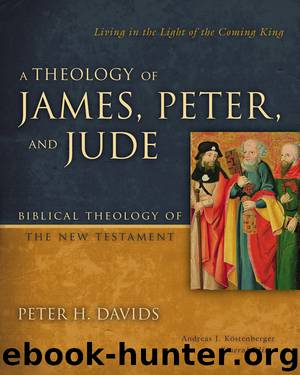
Author:Peter H. Davids [Davids, Peter H.]
Language: eng
Format: epub
Tags: REL067110 Religion / Christian Theology / Systematic
ISBN: 9780310519430
Publisher: HarperCollins Christian Publishing
Published: 2014-12-01T16:00:00+00:00
2:13
“accept the authority of” ὑποτάσσω hypotassō
2:18
“accept the authority of” ὑποτάσσω hypotassō
3:1
“likewise” … “accept the authority of” ὁμοίως … ὑποτάσσω homoiōs … hypotassō
3:7
“likewise” [no main verb expressed] ὁμοίως homoiōs
174. E.g., Plato, Laws 6.781; Republic 5.455, 457; Let. Arist. 250 (“the female sex is bold, positively active for something which it desires, easily liable to change its mind because of poor reasoning powers, and of naturally weak constitution”); Tacitus Ann. 3.34. See the many more references in Achtemeier, 1 Peter, 206, although he also notes that some of the same ancient writers could speak of “exceptions,” such as women who were not “womanish.”
175. Until the 1600s women on average lived shorter lives than men, for the loss of nutrients through pregnancy and lactation left them weaker and more susceptible to disease.
176. So Achtemeier, 1 Peter, 217; Davids, 1 Peter, 122–23.
177. The psalm conforms to the vocabulary of the LXX, but differs grammatically, principally in the shift from second to third person. Is this the result of following a different Greek text, of quoting from memory, or of deliberate theological adaptation? Note John Piper, “Hope as the Motivation of Love: 1 Peter 3:9–12,” NTS 26 (1980): 212–31, who argues that the shift in person was to make it a summary rather than command.
178. Achemeier, 1 Peter, 226, points out that while the reference in 3:7 to eschatological life sets the immediate context, the reference to present life in 2:24 and the return to present life in 3:13–16 mean that one cannot rule out a reference to present life, which is the thought of the psalm. Even so, eschatological life is the near context and must predominate.
179. The optative mood (paschoite, πάσχοιτε) along with “even if” (ei kai, εἰ καί) on the face of it should suggest that this outcome is improbable. However, the letter suggests elsewhere (e.g., 4:13–19) that precisely this outcome is being experienced and the “if” picks up on 1:6 and 2:19–20, and will be picked up (with optative) in 3:17. F. W. Danker, “1 Peter 1:24–2:17: A Consolatory Pericope,” ZNW 58 (1967): 100, argues that this optative indicates the desirability rather than potentiality of suffering for righteousness, which conclusion Elliott, 1 Peter (AB), 622, accepts. Achtemeier, 1 Peter, 230–31, however, argues that while the optative, rather than indicating remote potentiality, “may reflect the author’s indirect approach to the topic of suffering,” “it seems more likely to intend to express the fact that while Christians are not undergoing continuous suffering, they do live in an environment charged with suspicion and hostility, which has erupted and can erupt into violence and persecution at any time.” While various commentators line up with each of these views, what is clear is that the once fashionable idea that 1 Pet 4:12–5:11 was a separate letter reflecting a later time than 3:13–4:11 (i.e., a time when the persecution that was a remote possibility in the earlier passage has now become an actuality) is no longer seriously suggested, for the evidence for the literary unity of the letter is too strong.
Download
This site does not store any files on its server. We only index and link to content provided by other sites. Please contact the content providers to delete copyright contents if any and email us, we'll remove relevant links or contents immediately.
The Five People You Meet in Heaven by Mitch Albom(3550)
The Secret Power of Speaking God's Word by Joyce Meyer(3169)
Real Sex by Lauren F. Winner(3011)
Name Book, The: Over 10,000 Names--Their Meanings, Origins, and Spiritual Significance by Astoria Dorothy(2978)
The Holy Spirit by Billy Graham(2942)
0041152001443424520 .pdf by Unknown(2843)
How The Mind Works by Steven Pinker(2811)
ESV Study Bible by Crossway(2773)
Ancient Worlds by Michael Scott(2680)
Churchill by Paul Johnson(2577)
The Meaning of the Library by unknow(2564)
The ESV Study Bible by Crossway Bibles(2547)
The Gnostic Gospels by Pagels Elaine(2527)
MOSES THE EGYPTIAN by Jan Assmann(2411)
Jesus by Paul Johnson(2351)
City of Stairs by Robert Jackson Bennett(2340)
The Complete Dead Sea Scrolls in English (7th Edition) (Penguin Classics) by Geza Vermes(2270)
The Nativity by Geza Vermes(2226)
Ancient Near Eastern Thought and the Old Testament by John H. Walton(2221)
